
For the majority of the time, the market remains in a state of balance, with prices oscillating between levels like a ball in a corridor. However, sometimes one of these “limits” ceases to be a barrier and instead transforms into a springboard. The “Touch and Bounce” strategy is designed to capture precisely these moments: when the price touches a clearly defined range boundary and not only bounces back but does so with confirmed internal momentum.
It is important to note that this is not an attempt to predict a reversal in advance. Rather, it is a reaction to an already manifested fact—a stable change in behavior within a key zone.
The strategy is built on two proven tools: horizontal levels (marked manually) and the Stochastic Oscillator (14, 3, 3). Both are available in the Olymptrade trading platform toolkit. The former defines the location, while the latter confirms the timing. There are no moving averages, volume indicators, or multi-level filters involved—only structure and momentum.
How to Identify a Suitable Range
The strategy is activated when the market has been moving within a narrow but stable range for some time—at least 1.5 to 2 hours, with two or three clear touches of both the upper and lower boundaries. Such a range is easily identifiable visually: the price does not break out of the limits and consistently reverses upon approaching the edges.
During such periods, a level stops being a random line and becomes a zone of genuine interest where limit orders accumulate and expectations form. The more frequently the price has touched the boundary and bounced off it, the higher the probability that the next touch will also result in a reversal.
Signal Formation and Confirmation
An entry signal is formed in three stages:
- The Touch: The price must approach the boundary and touch it. It is not necessary for the candle to close beyond the level; it is sufficient for the candle’s wick (shadow) to reach the level.
- The Confirmation Candle: The subsequent candle must close in the opposite direction from the boundary. Ideally, this candle should have a body directed inward toward the range and a short wick pointing toward the level.
- Stochastic Confirmation: At the moment this confirmation candle forms, the oscillator must be in the overbought zone (above 80) if touching the upper boundary, or in the oversold zone (below 20) if touching the lower boundary. Additionally, it must begin to reverse, crossing the signal line toward the center. It is this coincidence—structural touch plus momentum reversal—that makes the signal reliable.
Suppose the price has bounced off the upper boundary several times, and now there is another touch. The candle displays a long upper shadow, a small body, and closes in the lower part. At this time, the Stochastic rises to 84, but on the next candle, it crosses the signal line downward. This is a “Touch and Bounce” signal. You open a PUT option.
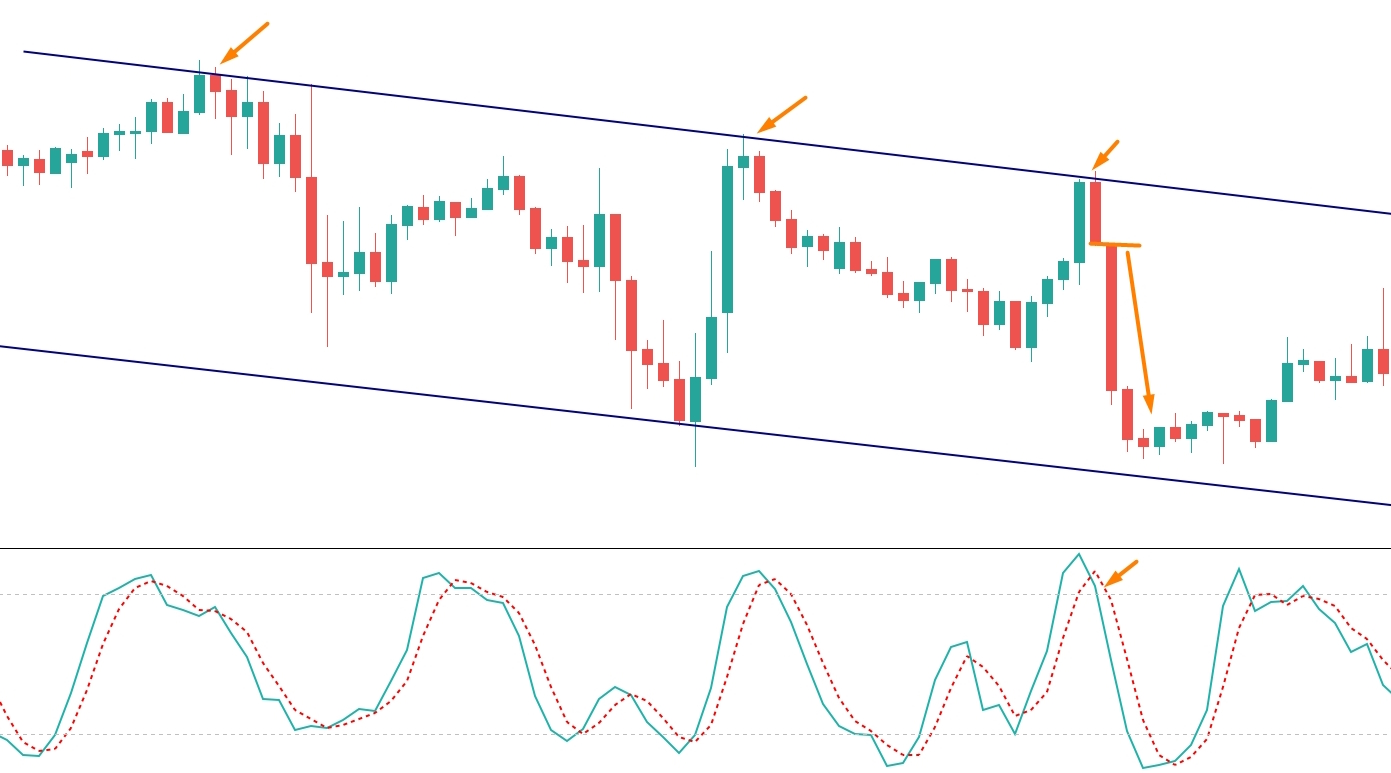
Conversely, when touching the lower boundary, if you see a bullish confirmation candle and the Stochastic reverses from the oversold zone, you open a CALL option.
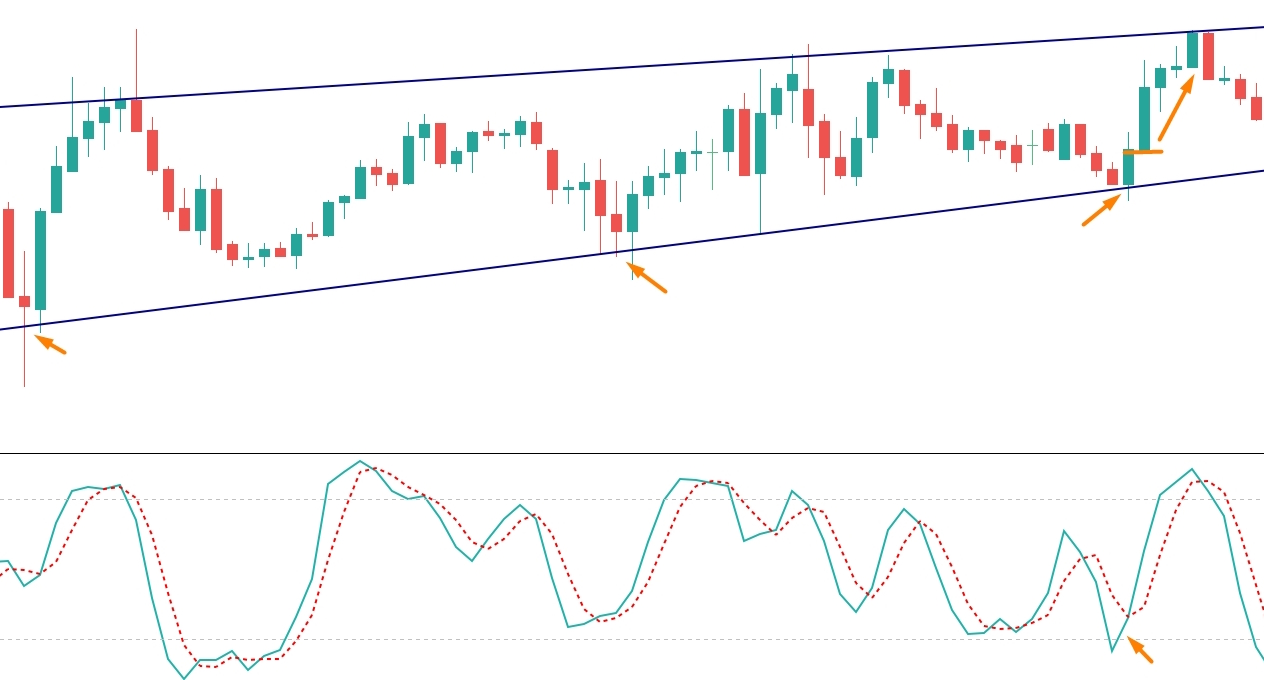
Select an expiration time between 15 and 25 minutes. This duration is sufficient for the price to traverse half or two-thirds of the range width, but not so long that it reaches the opposite boundary and reverses again.
Advantages and Limitations
Advantages:
- Simplicity: The levels are visible to the naked eye, and the behavior of the Stochastic oscillator is easy to interpret, even for beginners.
- Risk Minimization: The strategy minimizes risks by entering only after confirmation. You are not trying to “catch” the reversal; you are reacting to it.
- Moderate Signal Frequency: With approximately 2–4 signals per day, the strategy reduces trader fatigue and helps maintain discipline.
Limitations:
- Range Width: The strategy does not work if the range is too narrow (less than 10–12 points for currency pairs), as bounces in such conditions are often false, caused by market noise.
- Lack of Clear Confirmation: If the price does not form a clear confirmation candle after touching the boundary (e.g., several candles “hover” near the boundary), the signal is voided—the market has not made a decision.
- Manual Markup Required: The strategy requires manual drawing of levels, which excludes full automation. However, this develops the skill of reading market structure, which eventually works faster than any algorithm.
This methodology is particularly effective on assets with stable intraday volatility, such as EUR/USD and GBP/USD, as well as on cryptocurrencies during periods without major news spikes.
Conclusion
The “Touch and Bounce” strategy serves as a reminder: not all boundaries are meant to be broken. Some are meant to be bounced off. Your task is not to predict the bounce, but simply to see it and press the button at the right time.


